An Explanation of the World Heritage Convention’s Outstanding Universal Value
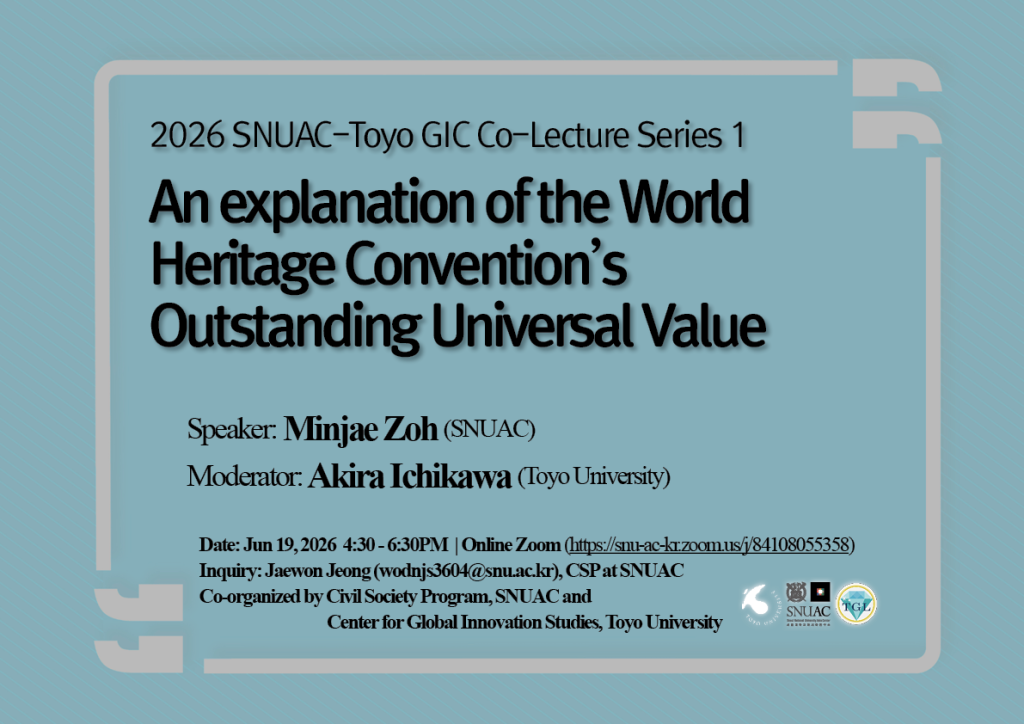
- Date: June 19th, Friday, 2026, 16:30 – 18:30
- Online via Zoom
Speaker: Minjae Zoh (SNUAC)
Moderator: Akira Ichikawa (Toyo University)
This lecture introduces and critically examines the concept of Outstanding Universal Value (OUV), the core standard used by UNESCO to determine whether a cultural or natural property merits inscription on the World Heritage List. More broadly, the lecture uses OUV as a starting point for exploring the idea of universalism, including questions surrounding shared human values, global citizenship, and the possibility of common international standards and goals. The lecture is organized into three main parts. First, it investigates how and why the concept of OUV emerged within the framework of the 1972 World Heritage Convention and how it was put into practice with the first World Heritage inscriptions in 1978. Second, it analyzes the meanings, motivations, and broader messages embedded in the concept, highlighting its connections to universalism, the Universal Declaration of Human Rights, and the principle of cultural diversity. Third, it traces the evolution of OUV over time, examining how the concept has adapted in response to changing understandings of heritage and ongoing debates concerning authenticity, integrity, representation, community participation, and sustainable development. By the end of the lecture, students will have a deeper understanding of how OUV functions not only as a technical criterion for World Heritage inscription, but also as an expression of global values and international cultural politics. Students are encouraged to contribute their own insights and to reflect critically on both the possibilities and the limitations of claiming that certain forms of heritage possess value for all humanity.