
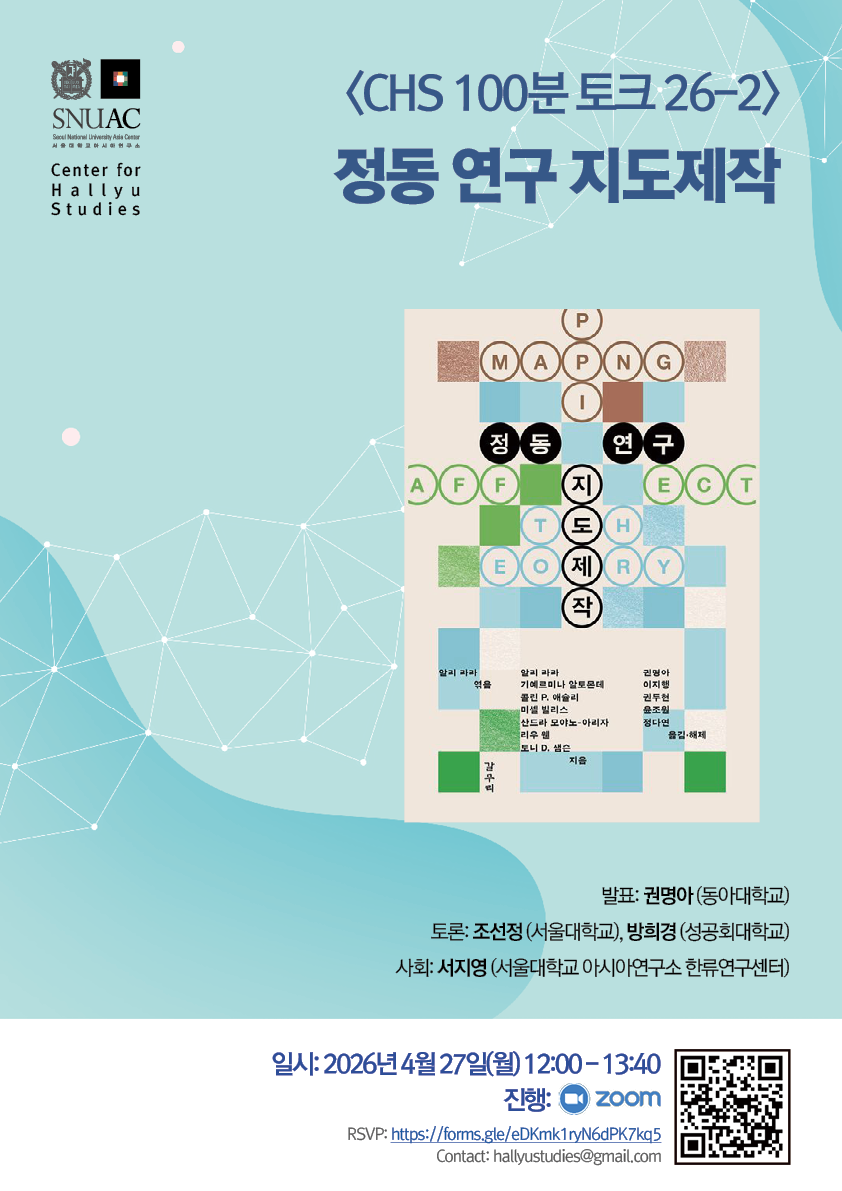
CHS 100 minute Talk 26-2: Mapping Affect Theory
- Date: April 27th, Monday, 2026, 12:00 – 13:40
- Online via Zoom
This book examines how the concept of affect relates to issues such as politics, subjectivity, labor, race, gender, and art, and provides an accessible guide to the key debates in affect studies. Affect studies began as a project that sought to explore what exists beyond, before, or outside representation, language, and conscious activity. In an effort to move beyond the epistemological regime of knowledge production, affect studies attends to processes that are reached in ways different from conscious action or discursively mediated interaction—in other words, to the processes through which subjectivity is produced by events and forces that occur beyond, beneath, above, or through them. The concept of affect is a key element in understanding the subjectivity, identity, and intimacies of contemporary workers both inside and outside the workplace. Taking affective blackness seriously means questioning the category of “affect and race” and proposing a model that focuses on particular forms of racial production and their distinctive capacities. In order to discuss the contribution of affect theory to literature and art—or the contribution of literature and art to affect theory—it is crucial to reconsider the problem of representation and its crisis. The encounter between queer theory and affect theory has called into question assumptions long taken for granted in each field, opening them to one another and enabling movement toward new theoretical horizons. Mapping Affect Theory proposes that we collectively begin the work of decolonizing affect theory and create new spaces in which new maps can be drawn.