- Home
- Events
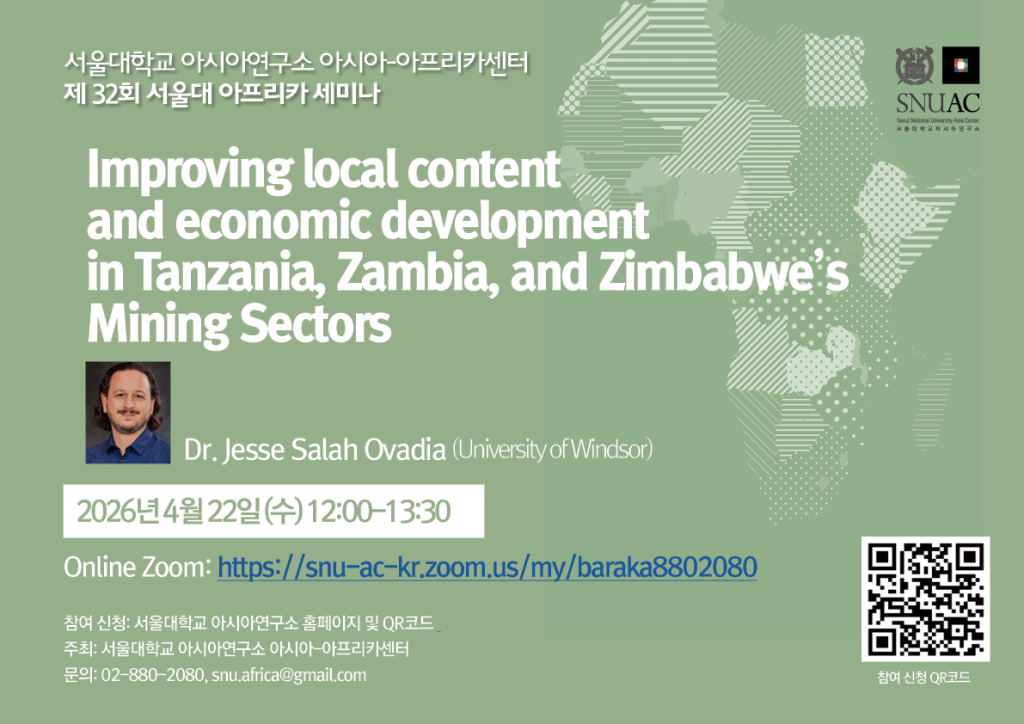
- Improving Local Content and Economic Development in Tanzania, Zambia, and Zimbabwe’s Mining Sectors
Improving Local Content and Economic Development in Tanzania, Zambia, and Zimbabwe’s Mining Sectors
- Date: April 22nd, Wednesday, 2026, 12:00 – 13:30
- Online via Zoom
Presenter: Jesse Salah Ovadia (Associate Professor, University of Windsor)
The 32nd SNU Africa Seminar, to be held on April 22, 2026, will host Dr. Jesse Salah Ovadia, Associate Professor at the University of Windsor, Canada. The seminar will examine local content policies in the mining sectors of Tanzania, Zambia, and Zimbabwe, analyzing their implications for economic development, industrial strategy, and their structural limitations.
Dr. Jesse Salah Ovadia is an Associate Professor in the Department of Political Science at the University of Windsor, Canada. His research focuses on African political economy, resource industries and development, and sustainable energy transitions. He received his PhD and MA in Political Science from York University, Canada, and a BA (Honours) in Development Studies and Political Studies from Queen’s University.
Dr. Ovadia serves on the editorial board of the Canadian Journal for Development Studies / Revue canadienne d’études du développement and is a contributing editor for the Review of African Political Economy. He previously held a position as Lecturer in International Political Economy at Newcastle University in the United Kingdom. Beyond academia, he has been active as an advisor and consultant for a number of international organizations, including the African Development Bank, UNDP, the Natural Resource Governance Institute, the UK Department for International Development, Engineers Without Borders, the African Climate Foundation, and the World Bank, contributing to policy discussions and practice in international development.
His research examines the political economy surrounding the design and implementation of state-led development strategies, particularly local content policies in the oil and gas sectors and broader energy transitions in Africa. His work analyzes how such policies aim to expand domestic participation and benefit-sharing in resource development while also exploring their implications and limitations for state governance, community development, industrial growth, and domestic and international relations. More broadly, his scholarship engages with issues such as development and underdevelopment, economic diversification, employment, and best practices in policy implementation and monitoring, offering insights that are relevant both to academic debates and to policy-making.
His work also examines how industrialization strategies, green transitions, and shifts in the global political economy shape development trajectories in the Global South. He has published widely on African industrialization, development states, and global production networks in leading academic journals such as World Development and Development and Change. In addition to his academic research, Dr. Ovadia contributes to policy debates on industrial development and economic transformation in Africa.