- Home
- Publications
- SNUAC Asian Studies in a Global Context Series
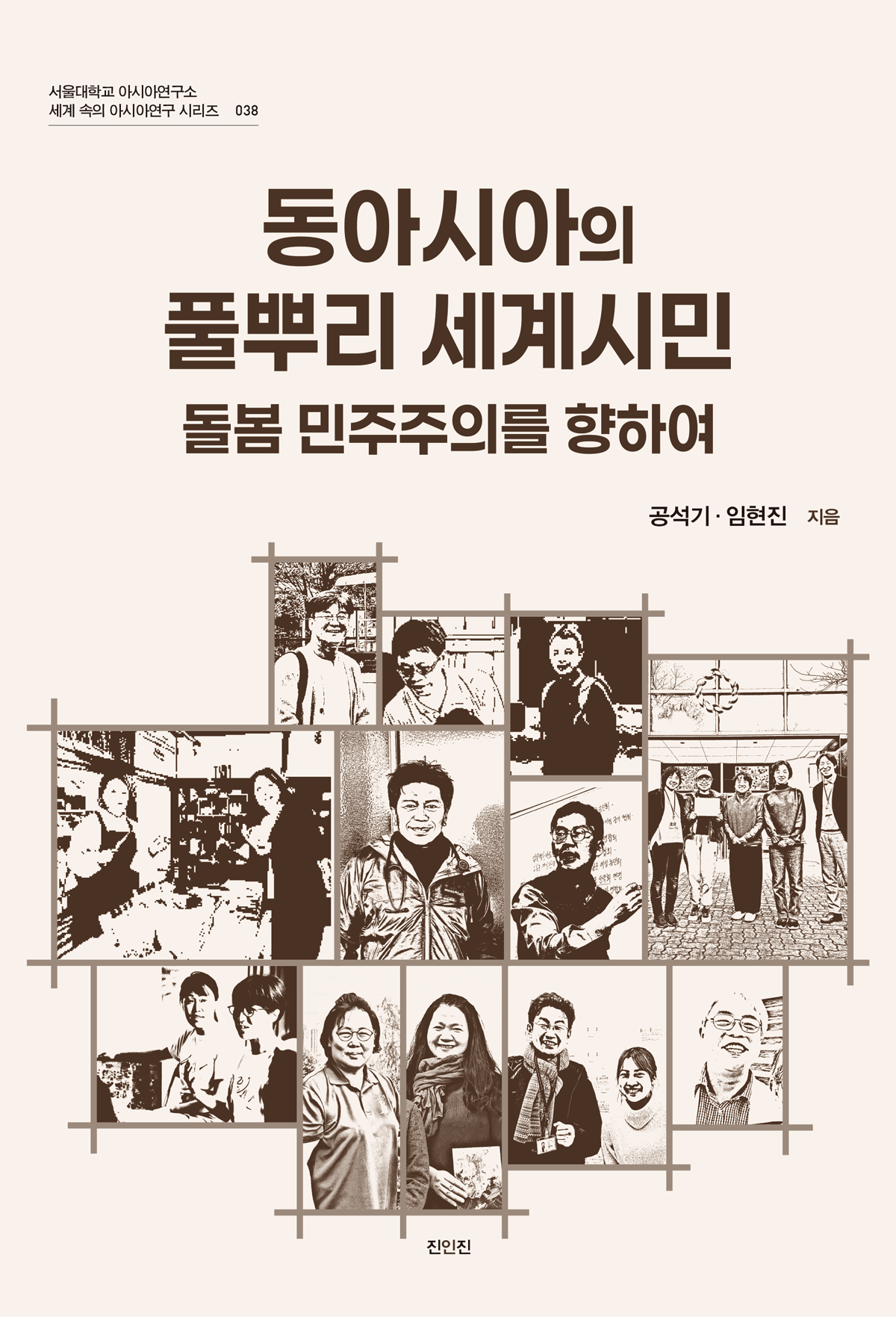
- Rooted Cosmopolitan Citizens in East Asia: Toward Caring Democracy
Rooted Cosmopolitan Citizens in East Asia: Toward Caring Democracy
- Authors: Suk-Ki Kong, Hyun-Chin Lim
- Publication Date: February/ 2026
- Publisher: Zininzin
About the Book
The twenty-first century world stands amid a series of intertwined crises: climate change, rapid population aging, extreme inequality, platform capitalism, democratic backsliding, and the collapse of care systems. These crises are not separate problems but rather symptoms of a broader civilizational transformation produced by the convergence of neoliberal globalization and digital capitalism.
This book begins with a fundamental question:
“Who will confront these crises—and how?”
The authors locate the answer not in the state, the market, or abstract discourses of global citizenship, but in “rooted cosmopolitan citizens”—grassroots actors working within local communities. Rooted cosmopolitan citizens address everyday challenges such as climate change, care, education, healthcare, aging, finance, and local economic development through practices grounded in relationships, cooperation, experimentation, and responsibility.
Based on more than a decade of field research and in-depth interviews conducted across East Asia—including Korea, Japan, and Taiwan—this book explores emerging forms of citizenship taking shape within local communities.
The authors propose a new model of democracy centered on three key concepts:
Rooted Cosmopolitan Citizens
Citizens who remain rooted in their local communities while recognizing and responding to global challenges.
Light Communities
New forms of community characterized by flexible participation and open, loosely structured relationships.
Caring Democracy
A political order that places the question—“Who cares for whom, and how?”—at the center of democratic practice.
Through these conceptual lenses, the book analyzes a range of social innovation initiatives across East Asia and identifies the emergence of grassroots global citizens. These cases are examined in relation to the dynamics of light communities and caring democracy.
Representative examples include:
-
Ecotourism initiatives by the Hangang Social Cooperative
-
Educational experiments for future generations at Kamiyama Marugoto University in Japan
-
Zero-waste regional innovation in Kamikatsu, Japan
-
Community healthcare initiatives in Dulan, Taiwan
-
Local education experiments by Starlight Social Cooperative in Chuncheon and Utsuho Elementary School in Wakayama, Japan
-
Senior community initiatives and financial care cooperative models
These cases are not merely local development projects; rather, they represent social experiments through which grassroots cosmopolitan citizens reconstruct democracy around the principle of care.
Building on this analysis, the authors propose a new social model: the regional care ecosystem. This model envisions networks of local cooperation linking ecology, education, healthcare, finance, and the social economy, offering an alternative civil society framework capable of addressing the multiple crises facing East Asian societies.
Rooted Cosmopolitan Citizens in East Asia: Toward Caring Democracy is both a scholarly study and a civic manifesto. It ultimately poses a question to its readers:
“In your community, who is building a caring democracy?”
Key Features
(1) A New Theoretical Framework for East Asian Civil Society Studies
Introduces the analytical concepts of rooted cosmopolitan citizens, light communities, and caring democracy.
(2) Based on More Than a Decade of Field Research
Draws on case studies and in-depth interviews conducted in local communities across Korea, Japan, and Taiwan.
(3) An Integrated Approach to Regional Innovation and Civil Society Research
Analyzes regional resilience by connecting ecology, care, education, healthcare, and the social economy.
(4) A Book for Scholars, Policymakers, and Practitioners
Offers practical insights for researchers, policymakers, and civil society activists.
About the Authors
Suk-Ki Kong
Research Professor in the Civil Society and NGOs Program at the Seoul National University Asia Center. His research focuses on civil society, local communities, grassroots democracy, and global citizenship, with ongoing fieldwork in Korea, Japan, and Taiwan.
Hyun-Chin Lim
Professor Emeritus of Sociology at Seoul National University, member of the National Academy of Sciences of Korea, and founding director of the Seoul National University Asia Center. A leading scholar of Korean civil society, he has published extensively on civil society, globalization, social movements, and democracy.
Recommended Readers
-
Researchers of civil society and local communities
-
Scholars in sociology, political science, and area studies
-
Public policy and local government practitioners
-
Activists working in the social economy and regional innovation
-
General readers interested in care, community, and democracy