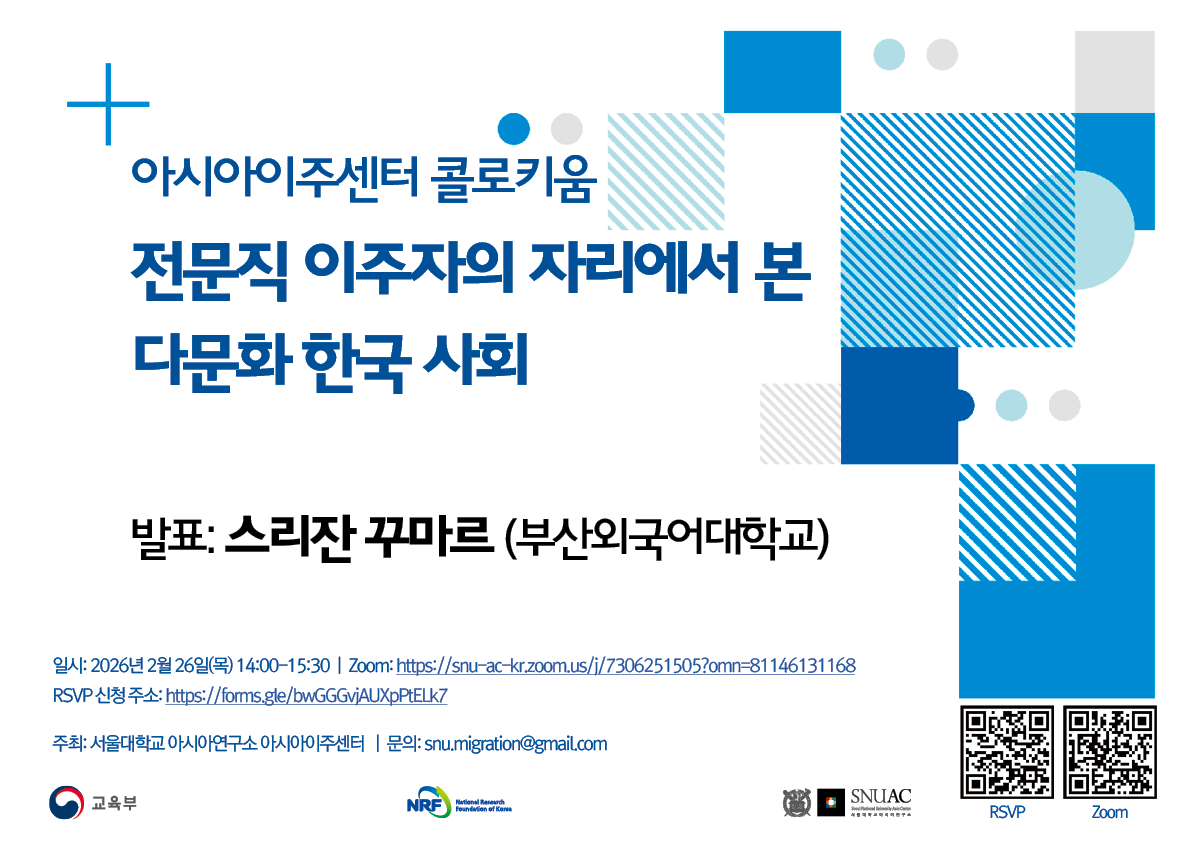
Multicultural Korean Society as Seen from the Position of Professional Migrants
- Date: February 26th, Friday, 2026, 14:00 – 15:30
- Online via Zoom
Speaker: Srijan Kumar (Assistant Professor, Hindi Major, Global Cultural Business and Global Liberal Studies, Busan University of Foreign Studies)
In this colloquium, “Multicultural Korean Society as Seen from the Position of Professional Migrants”, the presenter will revisit multicultural sensitivity and policy change in Korean society not from the perspective of a long-settled migrant who has become accustomed to local life, but from the standpoint of a migrant who, despite having reached the social status of a professional, must continuously negotiate and adjust across institutional, relational, linguistic, and cultural boundaries.
Tracing the period from entering Korean society as an international student in 2008 to the present in 2025, the presentation will offer a multidimensional account of how multicultural education has shifted—from an early phase in which it was first institutionalized and rooted in practice, to a stage in which broader structural transformation across society is being demanded—drawing on the presenter’s lived experience and work in educational settings.
The presentation will be structured by intersecting three levels: personal experience (micro), institutions and discourse (meso), and future directions (macro). Beginning with scenes encountered in classrooms and on campuses—such as issues of migrant language, qualifications, family, labor, and belonging—it will examine how these experiences have been connected to policy frameworks, institutional structures, and media discourse. Furthermore, at a moment when Korean society is effectively moving from being a “multicultural society” to debating its transformation into a “multicultural nation,” the presentation will raise questions about the next stage of this transition.
In particular, the presentation will evaluate social change in Korea through the lenses of diversity, equity, and inclusion, while reviewing achievements accumulated over the past 18 years—including changes in public awareness, expansion of institutional frameworks, and the development of educational and support systems. At the same time, it will discuss remaining challenges through concrete case studies.
Ultimately, this presentation aims to move beyond discussing multiculturalism as an abstract value, and instead open a space for dialogue on how an individual life history intersects with the chronology of social change, and what further transformations are needed to build a more inclusive society.