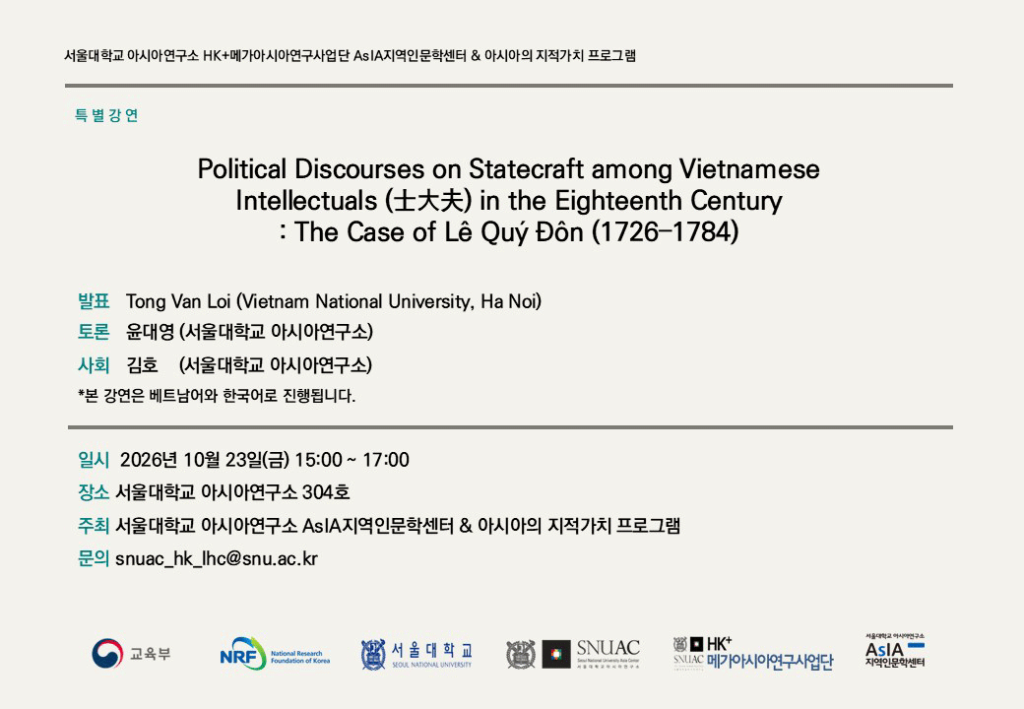
Political Discourses on Statecraft among Vietnamese Intellectuals (士大夫) in the Eighteenth Century: The Case of Lê Quý Đôn (1726–1784)
- Date: October 23rd, Friday, 2026, 15:00 – 17:00
- Location: Room 304, SNUAC (Bldg. 101)
In the eighteenth century, Confucian scholars in Vietnam, Korea, and other countries, as scholar-officials (士大夫), assumed the dual responsibilities of scholars and government officials and took a keen interest in the development of their countries and the welfare of their people. The intellectual elites of eighteenth-century Vietnam and Korea, particularly Lê Quý Đôn (1726–1784) and Jeong Yak-yong (1762–1836), emphasized practical learning (silhak, 實學) and harbored ambitions to contribute to state governance. Through diplomatic exchanges in Beijing, China, these scholars met and exchanged poetry and literary works, discovering shared intellectual and philosophical orientations regarding the governance of their respective countries.
Lê Quý Đôn was a high-ranking government official and renowned scholar in eighteenth-century Vietnam. He engaged in numerous encounters and exchanges with diplomatic envoys from Joseon in Beijing, creating rare opportunities for cross-cultural exchange between the two countries. To explore the intellectual contributions of prominent Vietnamese and Korean scholars, this presentation examines various aspects of Lê Quý Đôn’s life and thought.
Tong Van Loi received his Ph.D. in History from Vietnam National University, Hanoi, and is currently a researcher at the Institute of Vietnamese Studies and Development Science. His primary research interests include Vietnamese history and social history, with a particular focus on transformations in rural society in Vietnam’s Red River Delta during the seventeenth and eighteenth centuries, as well as how scholar-officials in northern Vietnam perceived and responded to the changing circumstances of their time.