- Home
- Events
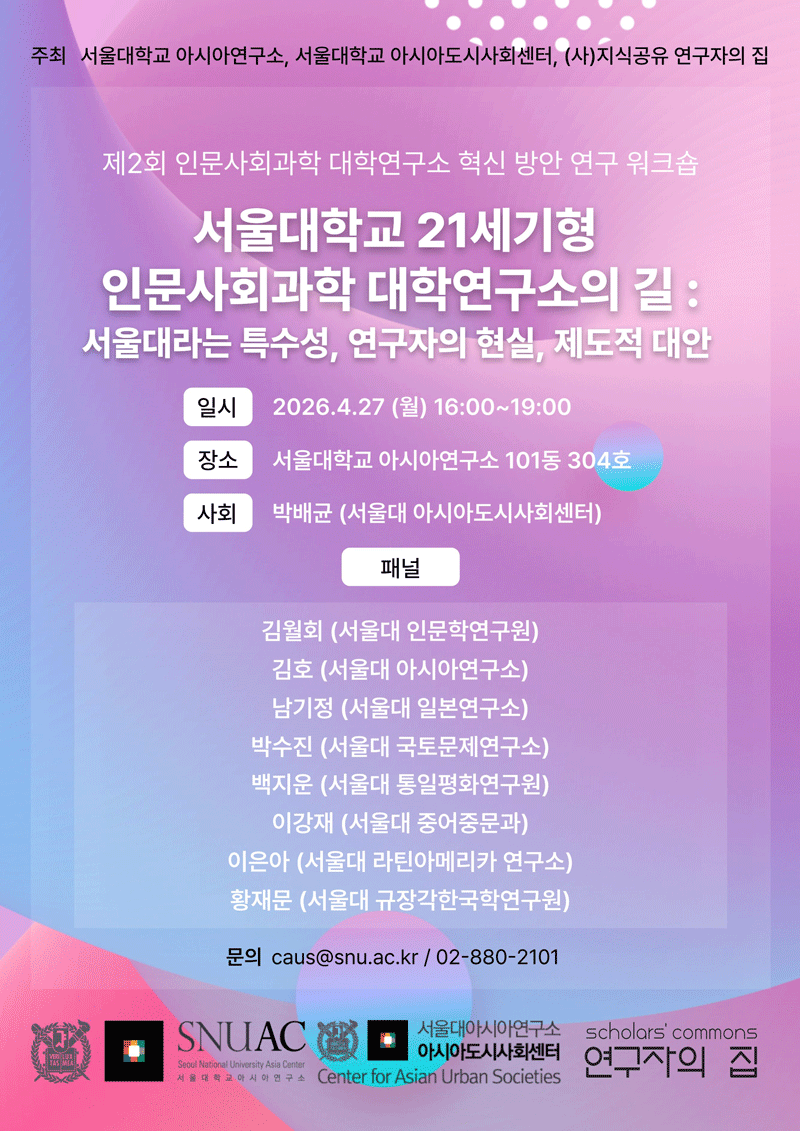
- The Path of a 21st-Century Humanities and Social Sciences Research Institute at Seoul National University: The Particularity of SNU, the Realities of Researchers, and Institutional Alternatives
The Path of a 21st-Century Humanities and Social Sciences Research Institute at Seoul National University: The Particularity of SNU, the Realities of Researchers, and Institutional Alternatives
- Date: April 27th, Monday, 2026, 16:00 – 19:00
- Location: Room 304, SNUAC (Bldg. 101)
□ Purpose of the Workshop Series
This workshop series has been planned as part of a collaborative research initiative aimed at strengthening the research capacity of humanities and social science institutes within universities, contributing to improvements in higher education and public value, and identifying ways to foster cooperation and mutual growth with diverse research communities. Through this ongoing series, the organizers seek to further develop discussions and contribute to the formulation of relevant policies.
The second workshop builds on the discussions from the first workshop on “Challenges and Public Roles of University Research Institutes,” shifting the focus to the concrete institutional context of Seoul National University. It aims to diagnose the realities faced by humanities and social science research institutes within SNU’s distinctive research culture and structure, while also paying close attention to the lives and precarity of researchers themselves. Ultimately, the workshop seeks to propose a 21st-century model for university research institutes as advanced research institutions, along with directions for institutional reform.
□ Theme
The theme of the second workshop is:
“The Path of a 21st-Century Humanities and Social Sciences Research Institute at Seoul National University: The Particularity of SNU, the Realities of Researchers, and Institutional Alternatives”
The workshop aims to examine the gap between the social responsibilities of these institutes and the realities of research practice, and to discuss policy alternatives for building a researcher-centered ecosystem.
□ Utilization of Outcomes
The discussions from the workshop will be compiled to develop policy proposals. These will be connected with subsequent workshops, ultimately leading to a final report containing policy recommendations for “innovating university research institutes in the 21st century and fostering sustainable coexistence with researchers.”
□ Program Schedule and Key Discussion Topics
Part 1: 16:00–17:30
- Opening Remarks: Bae-Gyoon Park (Director, CAUS)
- Congratulatory Remarks: Ho Kim (Deputy Director, SNUAC)
- Group Photo
Introductory Remarks & Panel Introduction (Moderator)
- Overview of the workshop’s purpose and goals for the second session
- Connection to key discussions from the first workshop (“Challenges and Public Roles”)
Agenda 1: Experiences of Operating Research Institutes within the Structure of SNU
- Sharing practical challenges in institute management, project execution, and outcomes
- Discussion of research collaboration experiences with other universities and institutions, and the distinctive features of SNU’s research environment
- Expectations regarding SNU’s social responsibilities and limitations observed in actual operations
Agenda 2: Changing Knowledge Systems in the 21st Century and the Social Meaning of University Research Institutes
- Reassessing the role of universities and research institutes in an era of shifting knowledge systems
- Defining the “21st-century university” and the role of humanities and social science institutes as advanced research institutions
- Examining SNU’s social responsibilities and public value
17:30–17:45 (Break)
Part 2: 17:45–19:00 (Dinner provided)
Agenda 3: People First — The Reality and Survival of Precarious Researchers
- The unstable research environment and policy limitations faced by non-tenure-track and independent researchers at SNU
- Addressing the concern that “the survival of universities and the humanities does not guarantee the survival of researchers”
- Identifying institutional reforms necessary to ensure researchers’ livelihoods
Agenda 4: Policy Recommendations for Change
- Institutional reforms at the SNU level (infrastructure, administrative support, status security, etc.)
- Policy demands and alternatives regarding government support for university research institutes
- Open discussion and concluding remarks
Closing