[News] Asia Regional Information Center Launches Data-Driven Platform “Understanding the Iran War Through Data”
[News] Asia Regional Information Center Launches Data-Driven Platform “Understanding the Iran War Through Data”
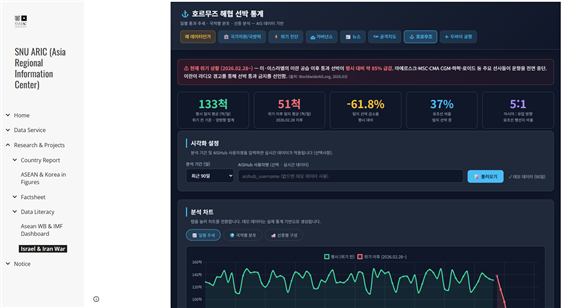
The Asia Regional Information Center (ARIC) at SNUAC has launched and officially announced a data-driven analytical platform titled “Understanding the Iran War Through Data.” The dashboard was developed in response to the rapid escalation of tensions in the Middle East during the first half of 2026. It is designed to provide a multidimensional analysis of the evolving situation using reliable indicators and real-time data, minimizing subjective interpretation in the face of the uncertainty inherent in wartime conditions.
A Multilayered Risk Analysis Framework
The platform approaches geopolitical crises through three analytical dimensions—state capacity, financial market signals, and institutional governance—to generate integrated assessments.
State capacity:
Using the World Bank API, the dashboard compiles key defense-related indicators such as GDP, military expenditure (as a percentage of GDP), total troop size, and arms import volumes. To enhance analytical precision, the platform employs an indexation method that measures the rate of change relative to a baseline year, rather than presenting simple time-series trends.
Financial and energy market signals:
By linking real-time data from Yahoo Finance, the platform tracks movements in WTI and Brent crude oil prices, the market volatility index (VIX), Israel’s TA-125 stock index, and currency fluctuations in major economies. These indicators quantify how financial markets perceive the severity of the crisis and serve as potential leading signals for policy decision-making.
Institutional governance and political regime:
Drawing on data from the World Bank’s Worldwide Governance Indicators (WGI), Freedom House, and V-Dem, the platform analyzes structural variables behind wartime decision-making, including political stability, control of corruption, rule of law, and levels of democracy.
Real-Time Monitoring of Economic Arteries: Strait of Hormuz and Dubai Airport
The dashboard also strengthens real-time monitoring of key logistical and energy chokepoints.
Strait of Hormuz:
Based on AIS (Automatic Identification System) vessel-tracking data, the platform visualizes daily shipping traffic, national distribution of vessels, and vessel types. Notably, it highlights the sharp contraction in maritime traffic—approximately an 85% decline compared to normal levels following the outbreak of the crisis on February 28, 2026—providing immediate indicators of disruptions to global energy supply chains.
Dubai International Airport:
Using ADS-B flight tracking data from the OpenSky Network, the system analyzes changes in air logistics and human mobility in the Middle East. Flight trends on major routes—including those linking India, the United Kingdom, and Saudi Arabia—are monitored separately to assess shifts in regional connectivity.
Spatial Visualization and Information Curation of Geopolitical Conflict
Attack mapping:
To identify geographic patterns of military confrontation, missile strikes across Iran, Israel, and other key locations in the Middle East are visualized through a Leaflet-based interactive map. The attack data are verified and updated by the research team based on publicly available reports and official announcements to ensure reliability.
Intelligent news classification:
Information collected from sources such as Google News, Reuters, and BBC is automatically categorized into four areas—military/combat, diplomacy/politics, economy/energy, and humanitarian issues—allowing users to identify strategically important developments within the overwhelming flow of news.
Significance of the Platform
The development of this dashboard is significant in that it provides scholars and policymakers with a data-based tool for objective assessment amid the extreme informational uncertainty of wartime. By quantifying variables such as Iran’s internal instability, economic resilience, and the effective level of disruption in the Strait of Hormuz, the platform establishes a foundation for deeper analysis of how the Middle Eastern crisis may affect political and economic orders across Asia.
ARIC plans to continue expanding its research activities by conducting ongoing monitoring and accumulating data through this platform, thereby offering a multifaceted perspective on geopolitical risks across the Asian region.