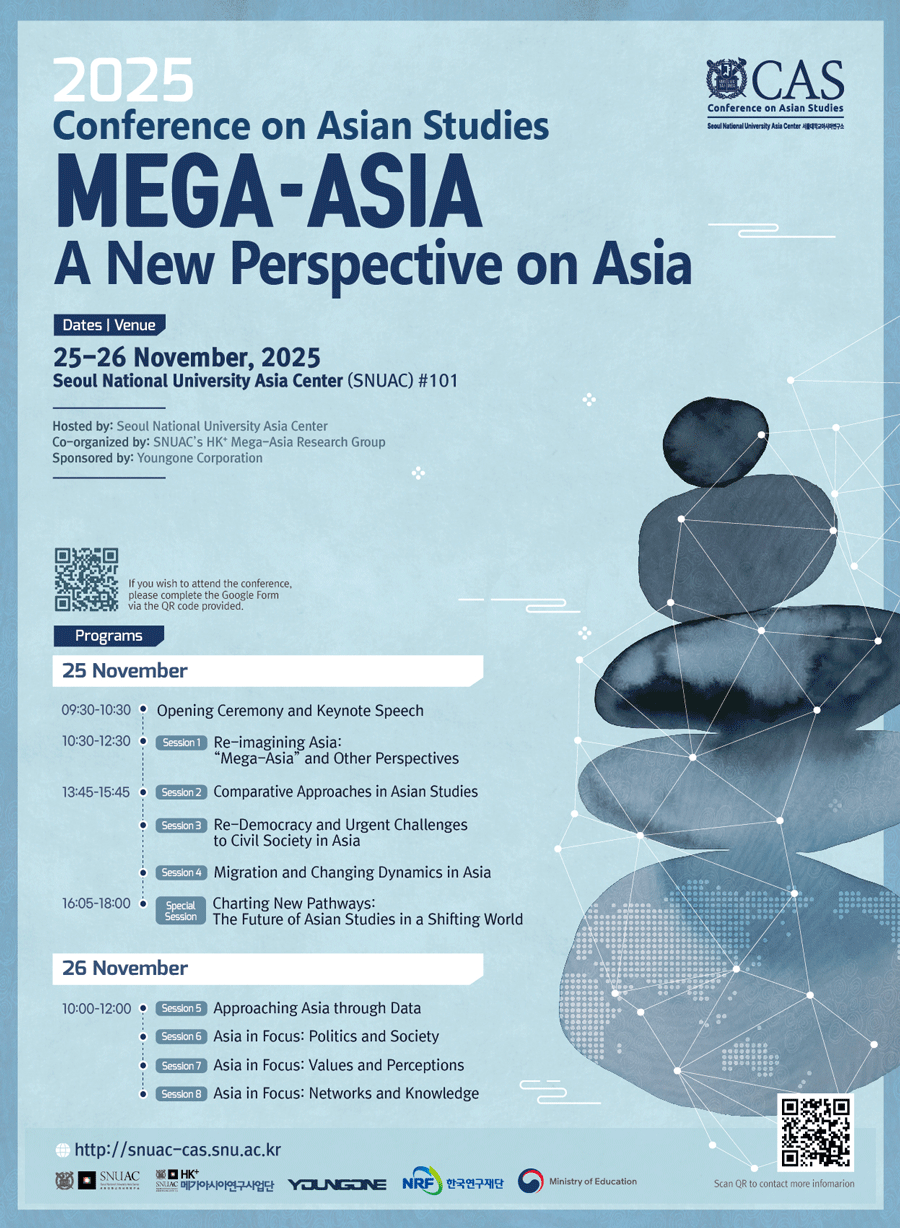
Mega-Asia: A New Perspective on Asia
- Date: November 25th-26th, Tuesday-Wednesday, 2025, 9:30 –
- Location: SNUAC (Bldg. 101)
The theme for the 2025 SNUAC Conference on Asian Studies is “Mega-Asia: A New Perspective on Asia.” The concept of “Mega-Asia” represents an innovative approach to understanding, analyzing, and envisioning the continent. As a concept, “Mega-Asia” reflects the processes and outcomes of the interactions among Asia’s diverse regions, each with distinct spatial and temporal identities, which give rise to new regional orders and phenomena. Methodologically, “Mega-Asia” involves employing a multi-scalar analysis, applying comparative approaches to regional studies, and utilizing a broad spectrum of data for data-driven research. As a way of imagining Asia, “Mega-Asia” aims to provide a shared ideological foundation that fosters collective responses to the challenges faced by Asia’s sub-regions and countries.
Since 2020, the HK+ Mega-Asia Project Research Group at SNUAC, supported by the National Research Foundation of Korea, has been exploring the idea of “Mega-Asia.” This initiative emerged from the need for a broader perspective on the region and the development of a conceptual framework capable of capturing Asia’s complex and evolving realities. Additionally, the experiences of the pandemic and its aftermath highlighted the importance of integrating both global and local perspectives, leading to research of a “glocal” nature—recognizing Asia’s shared characteristics and unique distinctions simultaneously.
Although “Mega-Asia” is a relatively new concept, the perspectives it offers are familiar to scholars of Asian Studies. Therefore, we invite researchers from around the world to join us in Seoul, Korea, in late November to engage in discussions on the “New Asia” of the 21st century—a megaregion evolving into “one space of multiple spaces,” shaped by diverse yet intertwined historical experiences.
Day 1
Keynote Speech by Prof. Dr. Patrick Köllner
“The Revitalization of Area Studies and the Role of Comparative Area Studies”
One aspect of the pragmatic turn supporting the recent revitalization of area studies (including Asian studies) is the increased compatibility of area-focused qualitative inquiry and comparative analyses within, between and across world regions. Comparative area studies (CAS) plays a crucial role here. As a self-conscious effort, CAS does two things at the same time. First, it balances deep sensitivity to context in each of the locales being examined with the use of some variant of the comparative method. The aim here is to surface causal linkages that are portable across world regions. Second, CAS has dialogical benefits by engaging research and scholarly discourse in two or more area studies communities against the backdrop of more general concepts and theoretical debates within a social science discipline.
Session 1: Re-imagining Asia: “Mega-Asia” and Other Perspectives
The “Mega-Asia” perspective emerged from the recognition that a new way of perceiving Asia is required for the 21st century. Developed out of this need was a research framework that supported the investigation of Asia at multiple scales, including the adoption of Asia itself as the unit of analysis. Such a multi-scaler approach allowed previously unrecognized connections between distant regions and countries within Asia to be explored and the reality and dynamics of an interconnected Asia to be revealed. This, in turn, allowed new sub-regions within Asia to be considered. Ultimately, this new way of approaching the region made it possible for Asia to be defined not by its otherness to the West but as an ever-changing concept, transformed and reconstituted by the dynamics of its respective (variously scaled) parts. In this session, the core concepts of the “Mega-Asia” perspective were introduced, along with a critical assessment of its possibilities and shortcomings. However, as the “Mega-Asia” perspective represents merely one of many ways of re-imagining Asia, we invited researchers to participate in this session to talk about other ways of approaching and perceiving Asia or its sub-regions. We welcomed contributions from both the humanities and social sciences, including historical analysis of past and present imaginations of Asia or its sub-regions (e.g. the Greater East Asia Co-Prosperity Sphere, Indo-Pacific, BRI, Zomia, etc.) or studies tracing how imaginations of Asia are constructed through discourse.
Session 2: Comparative Approaches in Asian Studies
In this session, the core concepts of “Comparative Regional Studies (CRS)” were introduced, along with a critical assessment of its possibilities and shortcomings. In addition, the ways in which “Comparative Regional Studies (CRS)” differed from “Comparative Area Studies (CAS)” were examined. We invited researchers who had applied the CAS methodology to Asian studies to participate in this session to present the results of their research and offer insights into the differences between CRS and CAS. There are, of course, various other ways of conducting comparative research on Asia that do not fall under the category of CAS or CRS. Therefore, we also invited Asian Studies researchers who had utilized other methods of comparative analysis to present their work at this session and demonstrate how their respective comparative approaches had been useful in identifying and tracing the drivers and dynamics of the relationships between Asia’s composite parts, ultimately facilitating the investigation of Asia’s identities diachronically, synchronically, and at multiple scales.
Session 3: Re-Democracy and Urgent Challenges to Civil Society in Asia
This session examined the evolving landscape of pro-democracy movements across the region. Through comparative case studies and discussions, it aimed to provide deeper insights into the dynamics of grassroots mobilization and the potential for regional cooperation in navigating the challenges of contemporary democracy. This session featured papers that addressed the resurgence of democratic activism, the transformative impact of the digital revolution, and the active engagement of the MZ generation in political and social movements. Additionally, the contributions provided insights into the rise of counter-movements that sought to undermine democratic efforts and offered analyses of how these opposing forces shaped the trajectory of civil society in Asia.
Session 4: Migration and Changing Dynamics in Asia
This session examined the ways in which migration practices contributed to shaping a more interconnected and networked Asia, with emphasis on the social, economic, and political implications of human mobility across the region. Ultimately, it aimed to provide a nuanced understanding of migration as both a structural phenomenon and an agent-driven process that continuously redefined Asia’s interconnected landscape. We invited papers that explored how migration practices could actively foster transnational connections, economic opportunities, cultural exchanges, and social networks that reinforced regional integration. We also welcomed contributions with a particular focus on issues of immigration governance in the context of neoliberal transitions and global inequality, which assessed how state policies, labor markets, and international frameworks influenced migration flows and the lived experiences of migrants.
Special Session
The special session entitled “Charting New Pathways: The Future of Asian Studies in a Shifting World” brought together institutional leaders and senior scholars to reflect on the evolving landscape of Asian Studies and to discuss new strategies for collaboration across disciplines and regions. In particular, it convened conference participants who were responsible for leading and managing Asian Studies research institutes and programs to exchange views on practical issues central to sustaining the field, such as identifying and excavating niche research agendas, mobilizing funding opportunities, and strengthening international and inter-institutional networks. Through this dialogue, the session aimed to foster new partnerships and actionable strategies for the advancement of Asian Studies in a rapidly changing academic and global environment.
Day 2
Session 5: Approaching Asia through Data
This session aimed to demonstrate how data should not be regarded merely as a supplementary tool for research but rather as an analytical instrument that gives empirical substance to various imaginations of Asia or its sub-regions, such as “Mega-Asia.” We invited researchers working with data to participate in this session and demonstrate the ways in which data could be used to illustrate how Asia is not a singular, fixed entity but a dynamic space shaped by overlapping and evolving historical experiences, economic interactions, cultural diffusion, and social mobility. Papers that addressed the challenges related to the application of data-driven research in Asian Studies—including issues such as data bias, uneven data accessibility, the balance between quantitative and qualitative analysis, and the need for collaborative work to facilitate context-sensitive interpretations of data-driven research results—were also welcomed.
Session 6: Asia in Focus: Politics and Society
This session explored the shifting political landscapes and social transformations that were redefining Asia’s position within the global order. By examining the intersections of geopolitics, civil society, cultural diplomacy, identity formation, and economic governance, the presentations collectively highlighted how local experiences and transnational dynamics intertwined to shape contemporary Asia. The discussions moved beyond state-centered narratives to consider how power, ideology, and community were negotiated across national, cultural, and economic boundaries. Together, the papers revealed Asia as a space of fluid alliances and evolving social imaginaries—where pragmatic cooperation, alternative civic forms, and cross-border solidarities coexisted with persistent inequalities and contestations. In doing so, this session invited reflection on the resilience and adaptability of Asian societies amid the pressures of globalization, populism, and rapid structural change, offering fresh insights into how politics and society in Asia continued to reconfigure the meaning of connectedness in the twenty-first century.
Session 7: Asia in Focus: Values and Perceptions
This session explored how values, beliefs, and perceptions shaped the ways Asian societies negotiated identity, resilience, and modernization amid shifting global and regional contexts. Across diverse case studies—from religious and moral frameworks to migration, technology, and industry—the papers collectively interrogated how normative systems and social imaginaries evolved in response to historical legacies and contemporary pressures. The discussions illuminated how “values” functioned not merely as inherited traditions or political rhetoric, but as dynamic tools for adaptation, contestation, and renewal. Whether manifested in transnational moral discourse, household coping strategies, digital communication across borders, or the interplay of competition and cooperation in Asia’s technology sector, values and perceptions emerged as the connective tissue linking individuals, institutions, and regions. Together, the presentations underscored the need to understand Asia not as a fixed cultural entity but as a living mosaic of ethical practices and worldviews, constantly redefined through exchange, interdependence, and the pursuit of meaning in an interconnected world.
Session 8: Asia in Focus: Networks and Knowledge