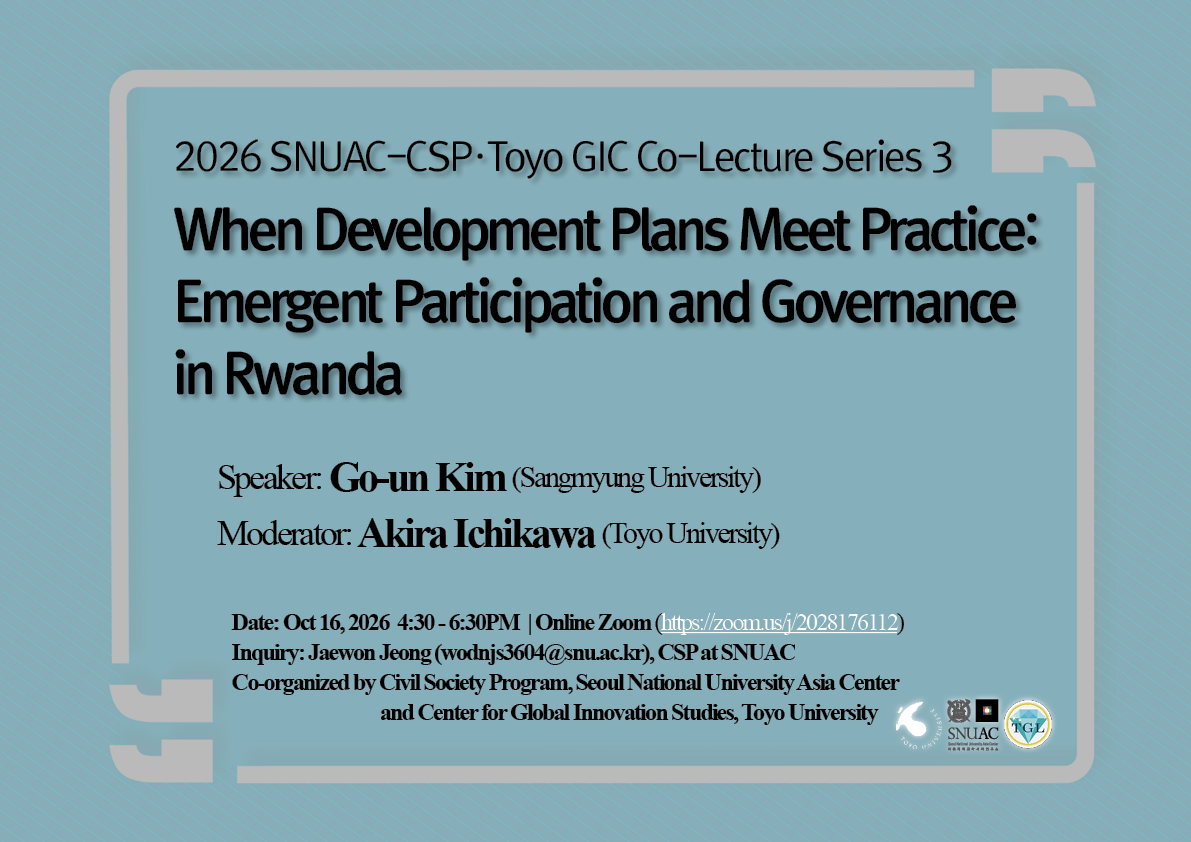
International development cooperation projects are commonly designed and managed around pre-established plans, performance indicators, and expected outputs. Yet as projects are implemented in the field, their meanings and practices may be reinterpreted and reconfigured through local needs and knowledge, institutional constraints and opportunities, and everyday interactions.
This presentation explores how development innovation took shape within the Korea-supported Saemaul Pilot Villages Project in Rwanda. Drawing on qualitative fieldwork, in-depth interviews, and document analysis, it traces two interconnected stories.
The first concerns a “Rwandan form” of rice cultivation. Although rice farming was not included in the original action plans, it gradually emerged as residents, Korean volunteers, local governments, and transnational agricultural knowledge networks adjusted project plans, conducted experiments, and learned through trial and error. The second story concerns women’s participation in the project communities. As women took part in cooperatives, a community kindergarten, and income-generating activities, the informal networks of care and livelihood that they had long sustained became visible as an important form of social capital. Women also assumed more active roles as public and economic actors. These processes created new opportunities for women to strengthen their public voice and economic agency, but they also relied heavily on women’s labor, much of which remained insufficiently recognized.
The presentation interprets these changes neither as a direct transfer of Korea’s economic development experience nor as the result of purely local initiative or self-help. Rather, it views them as co-produced outcomes arising from repeated interactions, informal and provisional coordination, trial and error, learning, and shifts in actors’ roles. To examine these processes, it draws on the concepts of emergent participation and emergent governance and considers the limitations of the conventional binary between top-down and bottom-up development.
Finally, the presentation asks how international development cooperation can remain accountable to established plans while creating meaningful space for locally grounded adaptation, learning, and innovation.