Speakers

홍석경 교수
한류연구센터장 / 서울대 언론정보학과 교수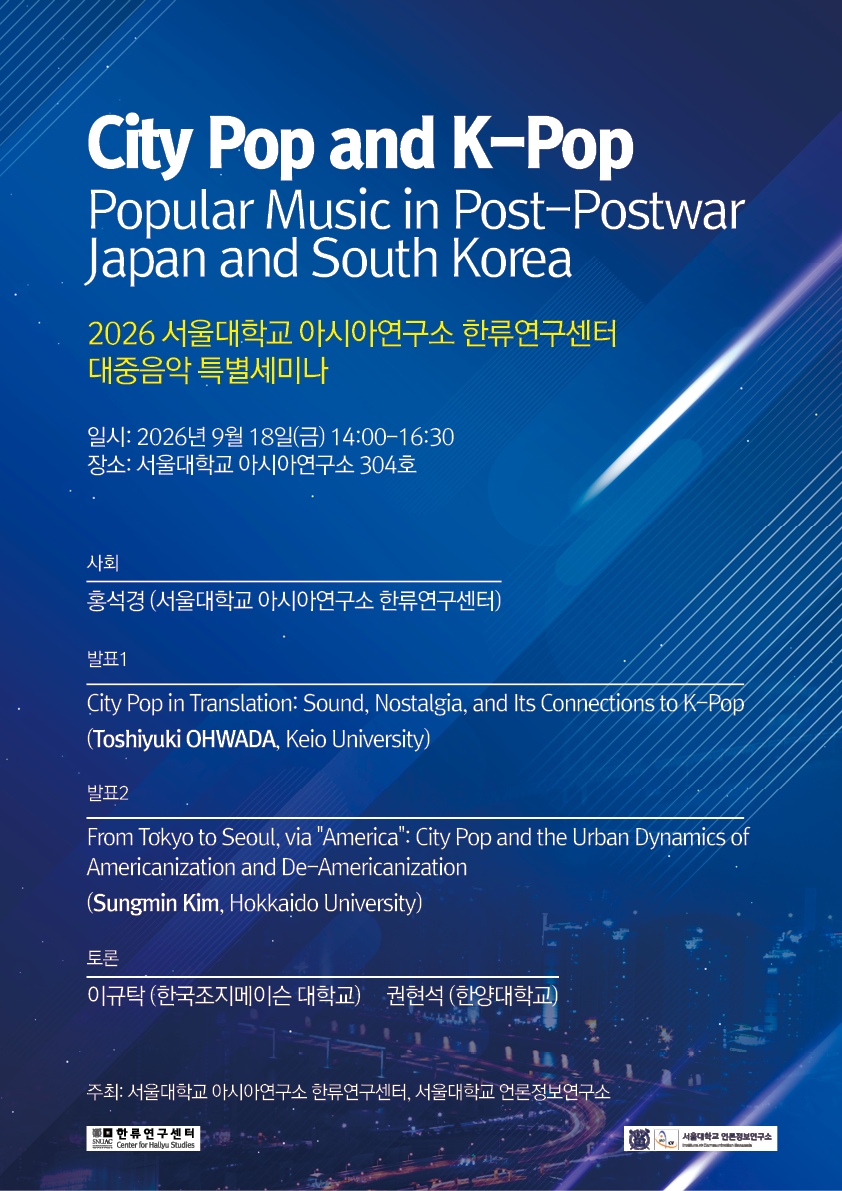
The global revival of Japanese City Pop has often been explained through internet circulation, vaporwave aesthetics, and an imagined nostalgia for 1980s Japan. After briefly reviewing these existing interpretations, this lecture explores the role of the musicians who created City Pop’s distinctive sound. Situating the genre within the emergence of nyū myūjikku (New Music) in the 1970s, I examine how freelance studio musicians transformed Japanese popular-music production through collaborative “head arrangements,” rhythmic experimentation, and the adaptation of American soul, funk, AOR, and jazz fusion. Although these musicians generally remained invisible to the wider public, their individual styles formed audible signatures that became central to City Pop’s identity. This emphasis on musical production also provides a basis for examining City Pop’s connections with K-Pop. In particular, I consider how City Pop’s sounds and imagery—as well as the forms of nostalgia associated with the genre—have been incorporated into selected K-Pop productions. How does this Korean reinterpretation resemble, and how does it differ from, the global image of City Pop produced through its recent revival? By tracing these processes of musical and cultural translation, I argue that City Pop is best understood not as a fixed national genre but as an evolving field of transnational exchange, collaborative authorship, and fabricated memory.
Review
지난 9월 18일(금), 서울대학교 아시아연구소 한류연구센터, 서울대학교 언론정보연구소, 서울대학교 현대한국종합연구단이 공동 주최한 대중음악 특별세미나 ‘City Pop and K-Pop: Popular Music in Post-Postwar Japan and South Korea’가 개최되었다. 홍석경 교수의 사회로 진행된 이번 세미나에서는 게이오기주쿠대학교의 오와다 도시유키 교수와 홋카이도대학교의 김성민 교수가 발표자로 참여하여, 2010년대 이후 전 세계적으로 주목받은 시티팝 현상을 동아시아 대중음악사의 미디어·산업적 연관성 속에서 다각도로 분석했다.
첫 번째 발표를 맡은 오와다 도시유키 교수는 <City Connections Its K-Pop Nostalgia, Pop Sound, Translation: and in to>이라는 주제로 시티팝 사운드를 형성한 스튜디오 세션 뮤지션들의 역할에 주목했다. 1970년대 ‘뉴뮤직’의 등장과 함께 활약한 이들 프리랜서 연주자들은 악보에 구속되지 않는 현장 협업 방식(Head Arrangement)과 리듬 실험을 통해 시티팝 특유의 정교한 사운드를 완성했다. 오와다 교수는 대중에게 비가시적이었던 세션 뮤지션들의 독자적인 연주 스타일이 시티팝의 청각적 서명이 되었으며, 이후 베이퍼웨이브(Vaporwave)와 인터넷 미디어를 거치며 겪어보지 않은 과거에 대한 그리움인 ‘안무이(Anemoia)’라는 가공된 향수로 재해석되어 K-Pop 프로덕션으로까지 이식되었다고 설명했다.
이어 두 번째 발표에서 김성민 교수는 <From “America”: Americanization City De-Americanization Dynamics Pop Seoul, Tokyo Urban and of the to via>을 주제로 1970~80년대 도쿄와 1980년대 후반 서울에서 일어난 미국 음악 자원의 번역 과정을 비교했다. 김 교수는 미국 음악이 도쿄의 스튜디오 기술 및 도시 소비문화와 결합하여 ‘도쿄 사운드’로 재조립되는 과정에서 ‘미국화’와 ‘비미국화’가 동시에 일어났음을 지적했다. 또한 1987년 민주화 전후의 서울 역시 미국 음악과 일본의 1차 번역된 음악 자원을 동시에 수용하는 이중 노출을 거쳐 독자적인 음악 생태계를 구축했다고 분석했다. 나아가 1989년 발표된 김현철의 음반 등이 2010년대 디지털 스트리밍 환경을 통해 ‘한국 시티팝’으로 사후 재범주화(Retrospective Categorization)된 맥락을 되짚으며, 시티팝을 단순히 일본에서 한국으로 일방 수출된 장르가 아닌 전 지구적 청취 장치로 해석했다.
발표 이후에는 이규탁 교수와 권현석 교수가 토론자로 참여하여 발표자들과 함께 시티팝의 미디어적 소비, 사후적 범주화의 한계, 그리고 K-Pop 역사 내 동아시아 대중음악 교류의 의미에 대해 깊이 있는 논의를 이어나갔다. 이번 세미나는 레트로 유행으로 소비되던 시티팝을 단순한 복고 현상을 넘어 동아시아 도시의 음악 노동과 미디어 환경, 그리고 초국적 번역의 역학 관계 속에서 새롭게 조명했다는 점에서 뜻깊은 학술적 성과를 남겼다